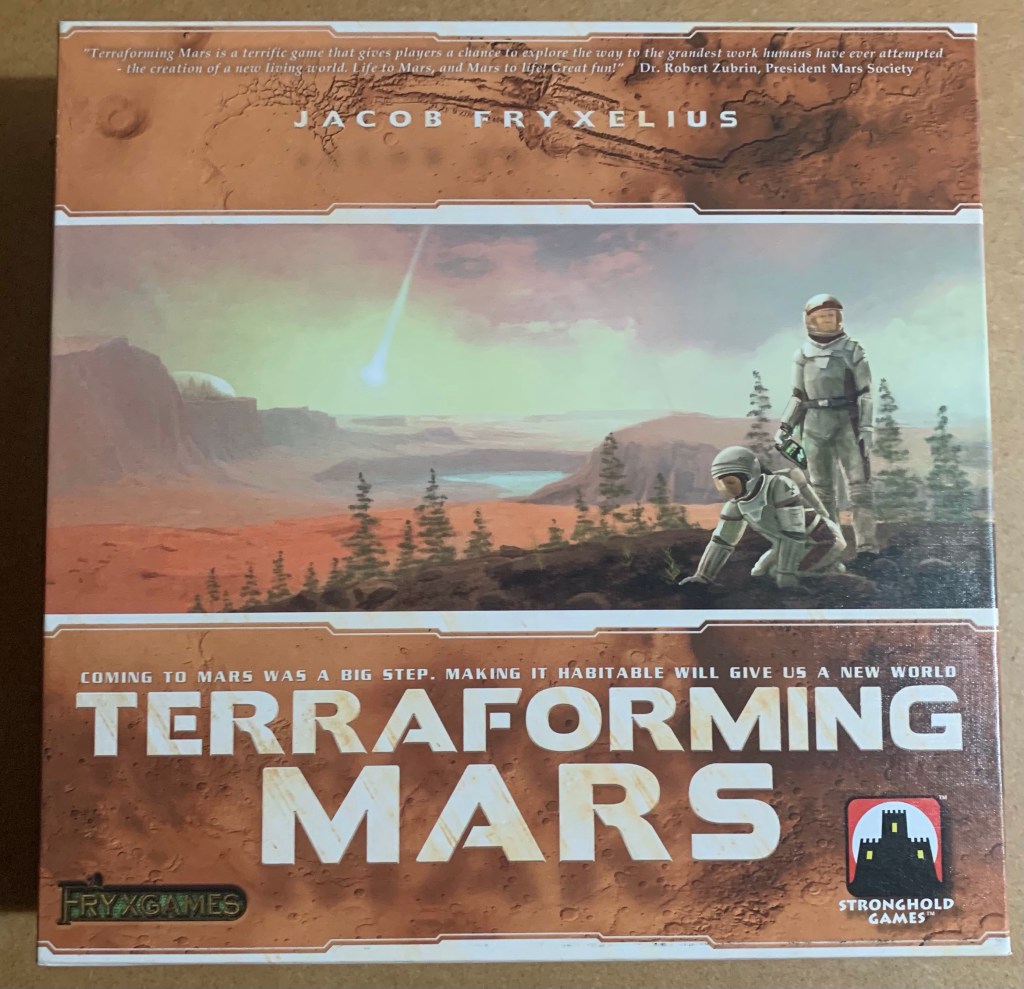
Terraforming Mars is a game for one to five players and was first published in 2016 by FryxGames. Since then it has gone on to become one of the top board game ranked by BoardGameGeek. Since it’s release it has had five expansions released for it (none of which I own…yet). The object of the game is pretty obvious by the title, terraform the planet Mars. This is done by raising the temperature from -30 to +8 degrees, raising the oxygen levels to 14% and cover 9% of the surface with water which is all done through various means. Each player represents a corporation wanting to get ahead and terraform the planet through different methods such as standard projects and patents but first they have to buy them. The game takes place over a number of generations until all three goals are met (or fourteen if you play solo).
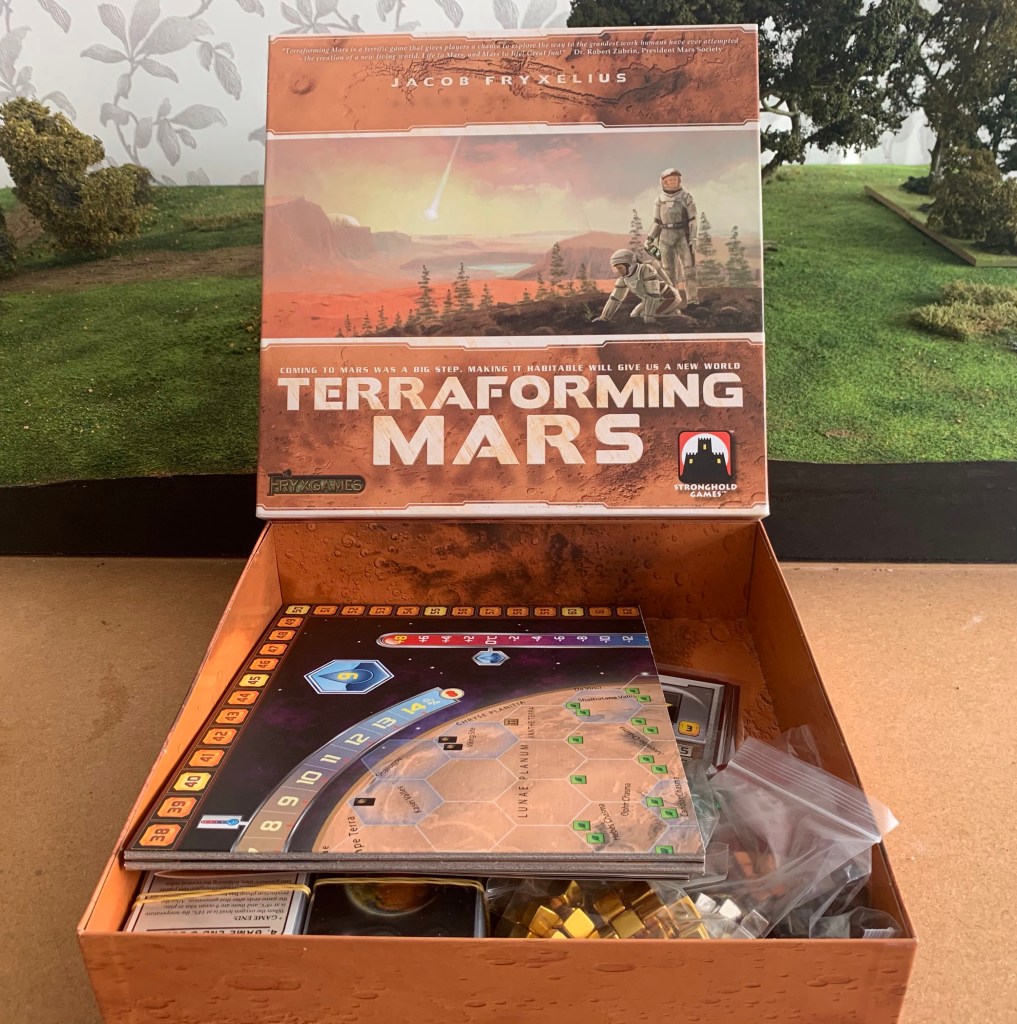
The components in the box are really well produced and easily stored. The cards have some really good artwork on them and the player boards are simple enough to navigate round. To help the shelf life of the game, I have sleeved all the cards and laminated the player boards. The different coloured cubes represent the different players as well as having gold, silver and bronze cubes to represent the games currency, Megacredits. The board has a representation of Mars divided into hexes with different areas of Mars that the hex tokens can be placed on such as oceans, forests and potential cities. There is a thermometer to track the temperature and counter for tracking the oxygen levels which is done using small white cubes. At the bottom of the board, there are different project and awards you can get and round the outside is the terraforming rating which is used to determine credits you earn and eventually who the winner will be. Setting up is fairly straightforward after few games but can be confusing when you first play.
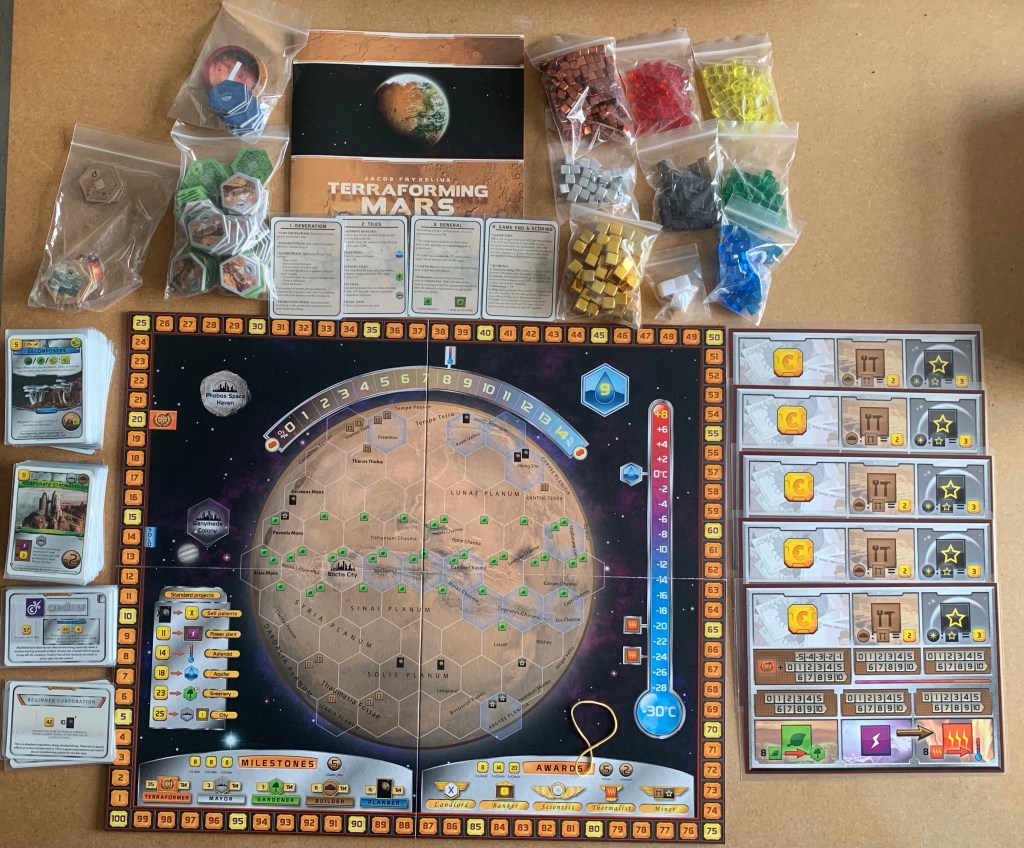
I have been lucky enough to play TM with others as well as solo and the gameplay styles are the same apart from the solo variant only having fourteen generations. A generation is one turn where all the players take one or two actions ranging from playing cards with actions, patents or events to undertaking standard projects and even giving themselves awards. Each player’s corporation is determined by dealing a corporation card to that player which will give them some starting megacredits and possibly production bonuses for their player board. Once each player has taken their actions the production phase begins. This is where you can build up your resources of steel, titanium, trees, power and heat as well as money. These resources can then be used to help pay the cost of cards, into tiles or to raise the temperature. Doing this will increase your terraforming points giving you the edge over your opponents. Cards can also help increase or decrease these resources for yourself or from your opponent. The rules are fairly straightforward and explained in a small rule book and also details what the anatomy of the cards and board are. There is a guide to what each icon means at the back and rules for three different variants one of which is the solo variant.
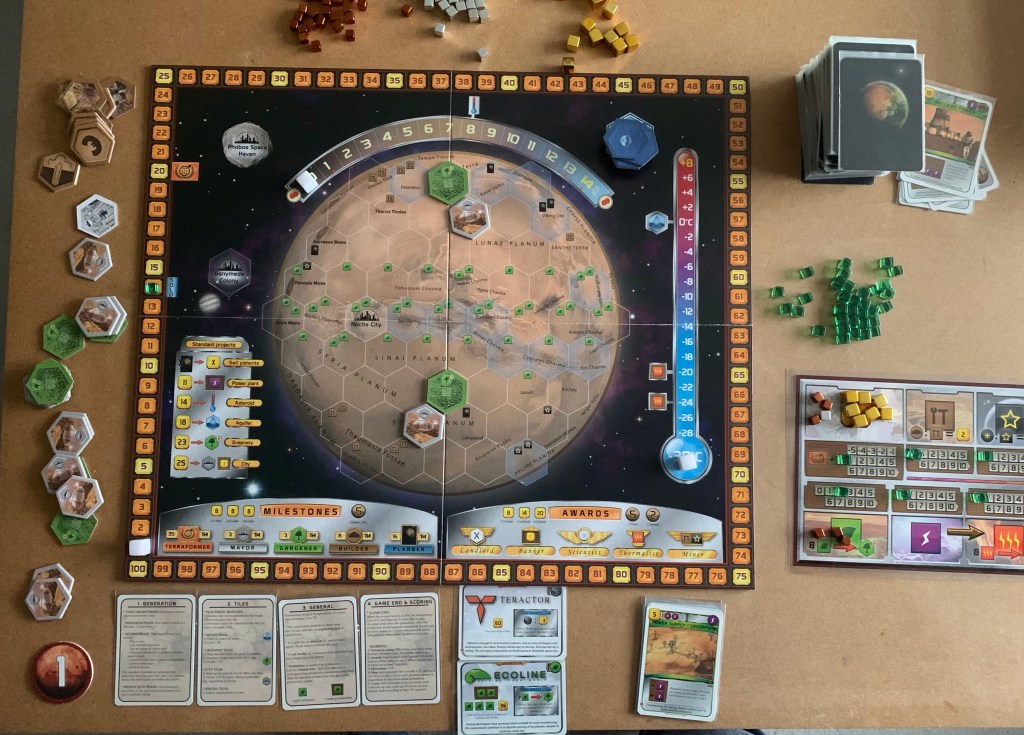
After a couple of attempts of getting the rules right, I finally played a proper game. I hadn’t played in a while so had forgotten a couple of small rules which actually impacted the initial game I played. I started with a decent amount of credits and production of trees which would help towards producing green tiles and oxygen for the planet. I selected some fairly average cards that could help increase energy production which would be vital in increasing the temperature. Money wasn’t flowing as well at first so had to be cautious of what I spent which slowed me down and didn’t really get the start I needed. By turn five I only had a couple of forest and ocean tiles but the temperature had not really gone up.

Things started to move a bit faster over the next few turns. My production increased a lot and I was being more mindful of the cards I was selecting and playing. I was buying cards that increased the game parameters like temperature and oceans to help get to the win conditions quicker. I was doing well but it started to slow down again. I was producing trees and energy to get the forests to produce oxygen and temperature up but needed to try and balance it out with other factors like using cards. By turn ten, I had increased the temperature and oxygen levels significantly and was getting ocean tiles down but only had four turns left to get it all done.
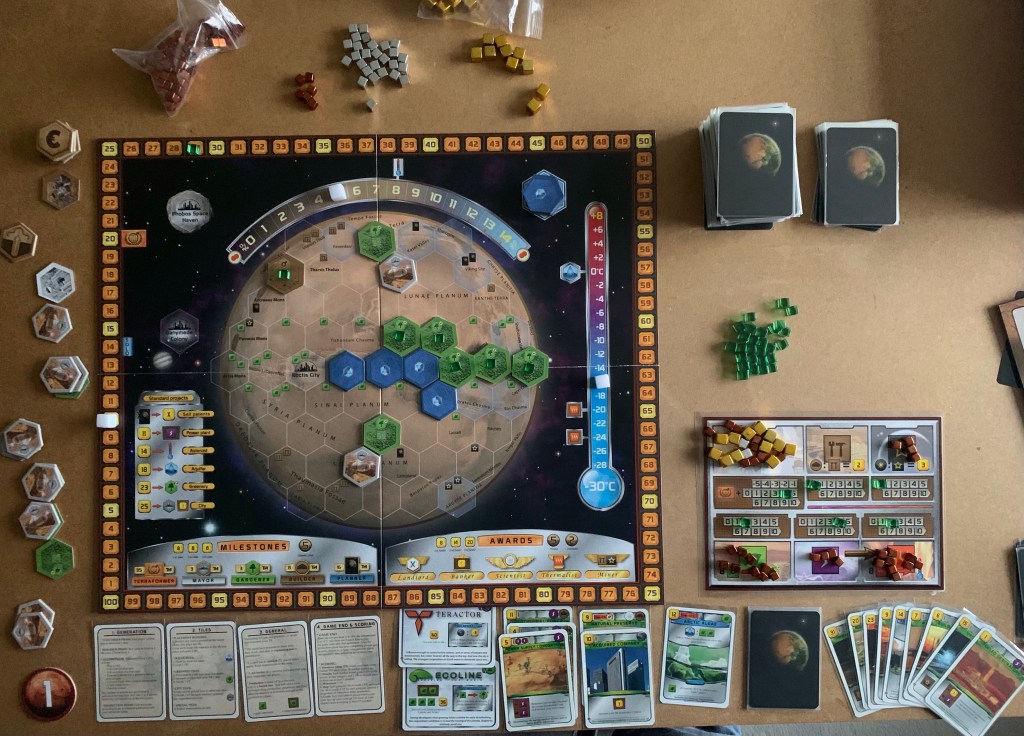
I was on a roll and it looked like I was going to do it but the cards were against me. I wasn’t drawing the cards I needed to increase multiple parameters like asteroids and comets. It started to slow down. I was still getting the production going but it was not enough. The temperature was up, oxygen levels were up and I had over half of the ocean tiles down but it wasn’t enough. It got to turn fourteen, the final turn, and I wasn’t going to win I needed to raise the temperature by sixteen degrees and the oxygen by 6% as well as place the remaining oceans all with two actions. It wasn’t going to happen. I completed the turn but hadn’t won. I did have nearly forty terraforming points which wasn’t bad going as I had started on fourteen as stated in the rule book for the solo variant but was pleased with my effort.
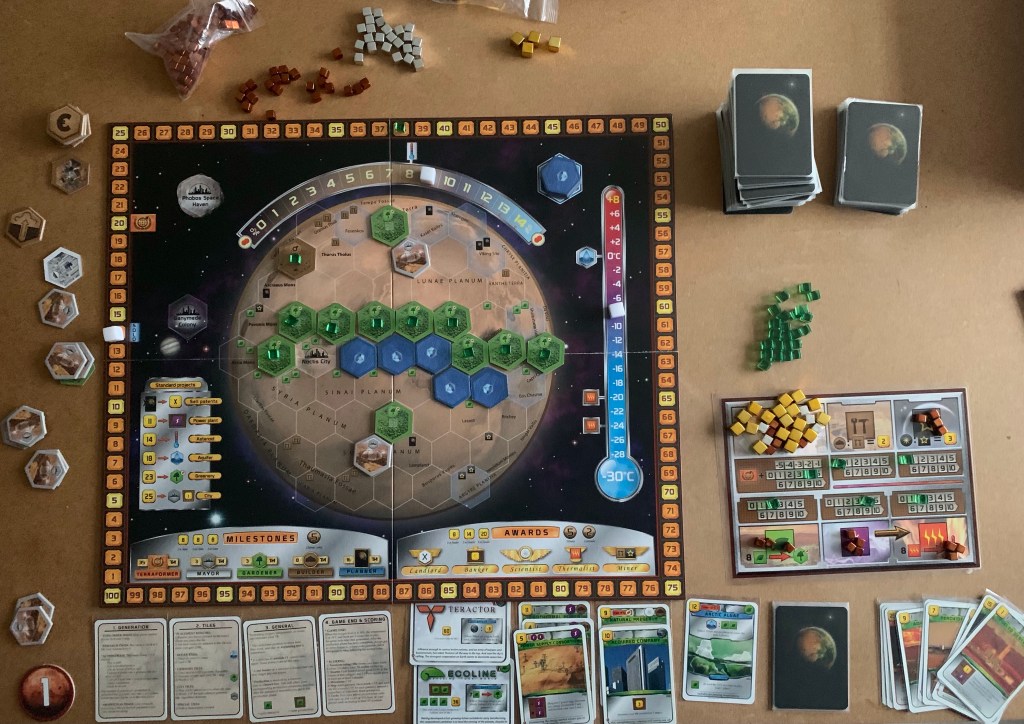
The game had taken around half an hour to play and didn’t really need to look at the handy rule cards that were provided in the box. Knowing that the solo variant doesn’t take long to play, I will make more of an effort to play it as I feel the need to try and beat the game. Multiplayer games will take longer and with the game only ending once all the parameters are met it tends to be a much longer game (I think it took us around 90 minutes last time we played it) but it offers a slightly more competitive edge to the game as you can screw your opponents over with some of the cards.
Overall, Terraforming Mars is a great strategy game, both solo and multiplayer, offering different tactics and strategies depending on your corporations and card draws. The only problem I’ve had with the multiplayer is that you can run out of coloured cubes making it hard to track resources. I would like to play it with four other people to get a real perspective on how cutthroat and competitive it can be but that will have to wait until another day…

 Tabletop Tales